
-
 SHOPPING CART item - 0
| ISBN | 9789355947369 |
| Binding | Hardbound |
| Pages | XIV, 154 |
| Year of Publication | 2024 |
| Language | English |
| Size | 23 cms |
| Subject | Agriculture , Economics , Rural Development , Philosophy , Sociology |
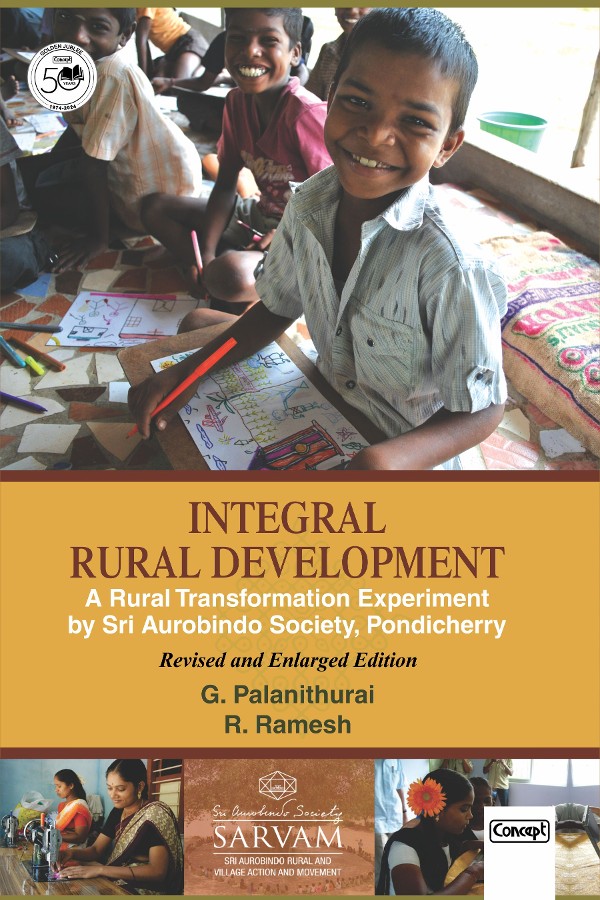
This book is the result of a dialogue between practice and reflection–reflective practice. The context is Sarvam’s rural development experiments in South Indian villages. Nearly two decades ago (in 2005), this experiment set out searching for answers to an important question. That was: How does development take place? The question itself was as intriguing as the answer was to be. The approach is engaging and reflective. This book is an observational account of the findings of an action research, which pursued finding the elements of fulfillment and self-awareness. It’s not merely about fulfilling physical needs and survival process as generally understood, when referred to rural / community development.
For humans to evolve as super humans as envisioned by Sri Aurobindo we need to move towards finding that element of fulfillment or self-awareness. This is discovering another great dimension to human life. This is moving towards an evolved self, and being able to come to terms with harmony with oneself, and his surroundings. We call it: Integral Approach to Rural Development. Since this is to do with elf-awareness and consciousness of individuals and communities – at times, we refer it to as: spiritual approach to rural development.
G. Palanithurai, Former Professor, Rajiv Gandhi Chair for Panchayati Raj studies, Department of Political Science and Development Administration, Gandhigram Rural Institute – Deemed University, Gandhigram is an academic activist. All his academic, research and outreach activities are being supported by an array of funding agencies, namely the world Bank, UNDP, UNICEF, Hunger Project, SDC, DANIDA, Action Aid International, Ford Foundation, Population Foundation of India, Rajiv Gandhi Foundation, Toolkit Foundation Netherland, Ministry of Panchayati Raj and State Planning Commission. He was a visiting professor in Cologne University, Germany. He has to his credit seventy three books, 126 research articles, 112 popular articles in popular newspapers, 83 monographs published in a span of three decades. He was and is member of many advisory committees of the Government of India and Government of Tamil Nadu pertinent to local governance and rural development.
R. Ramesh is working as Associate Professor at the National Institute of Rural Development & Panchayati Raj (NIRDPR), Hyderabad. He also works closely with the Ministry of Panchayati Raj and Ministry of Jal Sakthi in their training and capacity building efforts. He is associated with the Unnat Bharat Abhiyan (UBA) programme of the Ministry of Education. In UBA, Dr R Ramesh serves as a member of the Subject Expert Group, and also as a member of the National Coordination Committee of UBA Programme. His involvement in rural development spans over 30 years. He has published several books, papers and training manuals on rural development related themes. Before moving to work for NIRDPR Hyderabad, he worked for Sri Aurobindo Society, Puducherry for a brief period.