

-
 SHOPPING CART item - 0
| ISBN | 9788170229032 |
| Binding | Hard Bound |
| Pages | XVI, 254 |
| Year of Publication | 2001 |
| Language | English |
| Size | 23 cms |
| Subject | International Studies , Political Science |
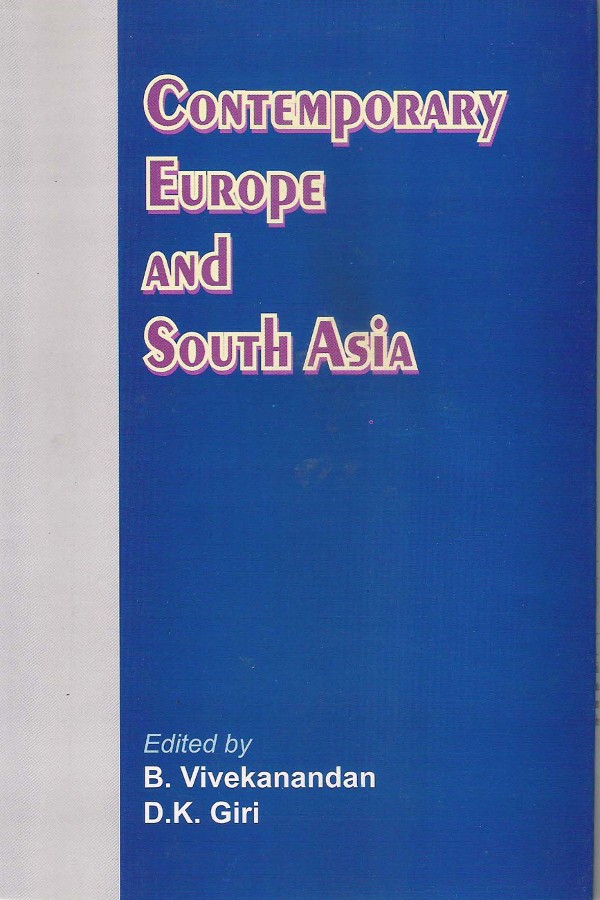
In this book, eleven eminent scholars drawn from Europe and South Asia have examined the relationship between contemporary Europe and South Asia. They have looked at its different facets from various angles. Though each essay has its won distinction and thematic completion, together they present a picture of a mosaic which characterises the features of relationship between contemporary Europe and South Asia in genera, and India in particular, with greater emphasis on the post-war scenario. Europe and South Asia, given their historical links and comparable developments towards regional integration, should have, close cooperative relations in the new millennium. But this is not automatically happening and South Asia continues to be on the margin of EU priorities. This book moves beyond the traditional approaches to bilateral trade relations between Europe and South Asia. The emerging pattern of international relations demands rethinking of North South relations-European Union as a powerful representative of the North and South Asia with most characteristics of the South. This book contributes to the process of the rethinking.
B. Vivekanandan is former Chairman of the Centre for American and West European Studies, School of International Studies, Jawaharlal Nehru University, New Delhi. He was Assistant Professor, Associate Professor and Professor at the School of International Studies, JNU, for 29 years. Also, he founded the Jayaprakash Foundation and was its President for 24 years. Professor Vivekanandan has to his credit many books including International Concerns of European Social Democrats; Welfare States and the Future; Pathfinders: Social Democrats of Scandinavia; The Shrinking Circle: The Commonwealth in British Foreign Policy, 1945-1974; In Retrospect: Reflections on Select Issues in World Politics, 1975-2000; Issues of Our Times; India Looks Ahead: Jayaprakash Narayan Memorial Lectures; Building on Solidarity:Social Democracy and the New Millennium; As the Mind Unfolds; Echoes in Parliament; Contemporary Europe and South Asia; and Why Social Democracy Besides, he has published a large number of research papers in several national and international journals of repute. He was Visiting Professor at Helsinki University, Finland, and at Carleton University, Canada, and was Visiting Fellow at the University of Constanz, Germany, Bruno Kreisky Archiv Foundation and Renner Institute, Austria, and at the Swedish Institute, Sweden. He was a Distinguished Visitor of the Jean Jaures Foundation, Paris.
D.K. Giri, is the Director, Schumacher Centre Delhi, which seeks primarily to contribute to revitalization of rural India by training and the application of appropriate technology. Having done his M.A. and M. Phil from Jawaharlal Nehru University (JNU) New Delhi, he obtained his Ph. D. from University of Hull, England, where he was associated with the Centre for Developing Area Studies, and the Centre for European Union Studies. Dr. Giri has done another Ph. D. on 'British Labour Party', from JNU, New Delhi.Having a brilliant academic record-first class distinctions and merit scholarships throughout his career-Dr. Giri has taught in Jamia Millia Islamia, New Delhi, and has been guest lecturer in the universities in India and abroad. He has a wide range of academic interest with specialization on developmental issues and contributes regularly to the leading journals. Dr. Giri has travelled widely in connection with his research/lecture programmes. The countries he has visited include United Kingdom, France, Germany, the Netherlands, Belgium, Luxembourg, Sweden, Finland, Denmark, Spain, Portugal, Ireland, the former Soviet Union, Afghanistan, Poland.


